Telescopic handlers solve material placement challenges that standard warehouse forklifts cannot manage on raw residential and commercial ground. In older neighborhoods like the Fairmount Historic District or Ryan…
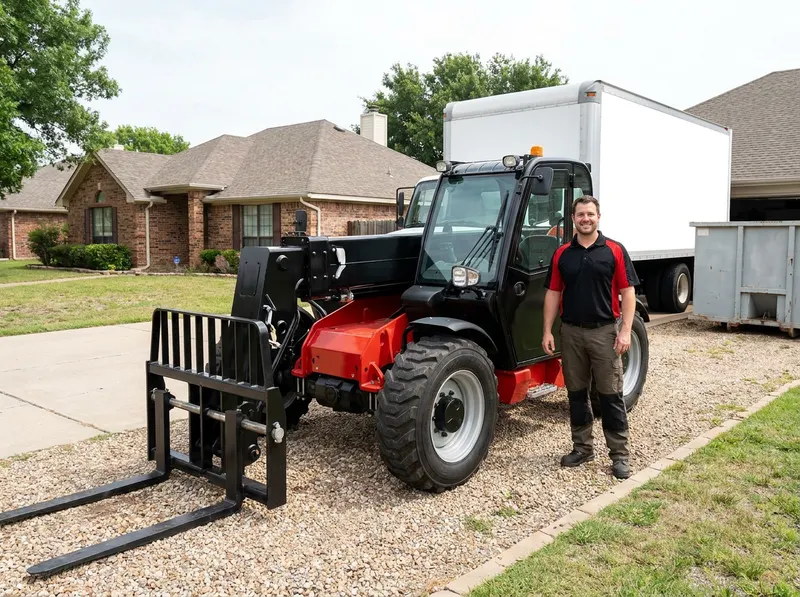
Telescopic handlers solve material placement challenges that standard warehouse forklifts cannot manage on raw residential and commercial ground. In older neighborhoods like the Fairmount Historic District or Ryan Place, tight residential lot lines and mature pecan trees limit access for full-size boom cranes. A compact 5,500-pound telehandler with an 8-foot outward reach fits down alley access points to hoist structural beams, framing packs, and palletized masonry over fences directly to a second-story deck. Standard rough-terrain forklifts employ vertical masts suited for unloading heavy pallets over flat packed earth, but they lack forward reach. When an open trench, drainage swale, or muddy setback separates the staging lane from the installation line, a variable-reach telehandler bridges that physical gap by extending payloads directly across obstacles without repositioning the vehicle.
Ground composition dictates axle and tire selection across Fort Worth jobsites. Commercial pad builds out in Alliance and residential rebuilds in Arlington Heights encounter expansive black clay that turns to thick slurry after heavy rainfall along the Trinity River basin. Conventional dual-wheel warehouse units sink instantly in wet clay, while rough-terrain telehandlers utilize foam-filled, deep-lug pneumatic tires alongside selective four-wheel drive and frame leveling up to 10 degrees. For jobs near the Cultural District and around TCU-Westcliff, overhead clearance below historic live oaks and neighborhood utility lines demands low-profile cabs measuring under 80 inches in transit height. Choosing an oversized 55-foot telehandler provides substantial height, but the machine weighs upwards of 31,500 pounds, requiring heavy hauling permits on residential roadways and steel plates to prevent driveway cracking.
Operational logistics require specific planning before delivery. Telehandlers function as variable-reach pick-and-carry loaders rather than earthmovers; operating with an extended boom while traversing slopes invites tip-over risks governed by strict load chart limits. If material must land on a residential roof pitch, a 42-foot or 44-foot machine with outriggers provides the stability baseline required for safety. For ground distribution across flat, packed construction yards near the Stockyards, a straight-mast rough-terrain forklift lowers fuel consumption and speeds up multi-pallet loading cycles. Pricing scales predictably: compact 19-foot units handle light pallet movement, while 10,000-to-12,000-pound high-reach telehandlers manage multi-story framing grids. Transparent dispatch avoids secondary surcharges by setting clear fuel-return guidelines and equipment offload requirements before transport trailers depart for the site.
Every job gets a firm, written price after a free on-site visit.
Tell us about your telehandlers & rough-terrain forklifts job in Fort Worth and we'll send a clear, written quote, usually the same day.
 Sunset Ridge Dumpster Rental